
Ceasefire in Lebanon ... without ceasing fire
A compilation tracking consequential & strategic observations -- Analysis & reports from the Arabic press and leading regional commentators (21 June 2026)
Despite the MoU guaranteeing the “sovereignty and respect for the territorial integrity of Lebanon”, skirmishes in Lebanon will clearly continue. This appears to be acceptable within the wider context of the US-Iran MoU.
Representatives of Hizbullah have agreed to a two month period before a full Israeli withdrawal from Lebanon. Parliament Speaker Nabih Berri “reaffirm[ed] Lebanon’s position and Hezbollah’s commitment to the ceasefire, as long as Israel adheres to it fully and comprehensively”.
Israel’s offensive in Lebanon is failing and the domestic repercussions in Israel are evident.
Israel has continued to attempt to expand its presence in south Lebanon through military offensives and bombings — its self-declared 10km security zone has now been expanded to a 10-14km security zone — which includes strategic hilltops beyond the Litani — reported to be the location of a sophisticated Hizbullah missile infrastructure complex. The Ali Taher ridge was originally not included in the IDF security zone in south Lebanon, but this week the IDF published an updated map of what it calls its “forward defence area” which now includes the Ali Taher ridge.
On 20 June, Netanyahu announced that Israel would adhere to the US co-ordinated ceasefire, EXCEPT in the 10km+ self-defined Israeli ’security zone’ — suggesting Israel will continue trying to capture the Ali Taher ridge. As one commentator notes: “In other words, there is no ceasefire at all, tensions over Lebanon will continue to escalate”.
Al-Akhbar notes: “Israel is treating the period of relative calm as an opportunity to reshape the reality on the ground … including reinforcing its positions north of the Litani River and establishing new military deployment lines, thus transforming territorial control into a bargaining chip for future negotiations”.
In parallel, Israel continues to use “evacuation orders” to depopulate, occupy and enable its ‘freedom of action’ in Lebanon. Current IDF “evacuation orders” amount to a total of 15% of Lebanon.
Parallel to the MoU, the US has increased financial and political pressure on Hezbollah and its allies (including the Christian leader Suleiman Frangieh) in an attempt to tighten the noose around the party through a new package of US sanctions.
Head of the Loyalty to the Resistance Parliamentary Bloc Mohammed Raad restated Hizbullah’s commitment to “an internal national understanding that guarantees the security, stability, and national sovereignty of Lebanon”.
Michael Young outlines that a Saudi-led Regional Coalition has been addressing an ‘organised gradual transition’ initiative, rather than the ‘forced disarmament’ of Hizbullah — as opposed to the US-managed scheme that is “designed to precipitate [Lebanon’s] armed forces into a devastating confrontation with [Hizbullah]”.
Ibrahim Al-Amine, editor of Al-Akhbar, writes: “President Aoun and Salam, along with other Lebanese forces ... are pushing for an agreement that imposes the comprehensive disarmament of Hizbullah and allows for steps to be taken to dismantle its political, organisational and social structure … [They] are preparing to commit the gravest of crimes by entering into a security agreement with Israel … due to be finalised within a week or by the end of [June], followed by … Aoun’s visit to the White House, where the agreement is expected to be signed … Trump wants to give Netanyahu a card to play in Tel Aviv to justify any potential withdrawal from Lebanon, but something could happen to derail this entire plan”.
Lebanon’s Ministry of Health has confirmed that more than 3,980 Lebanese have been killed and 12,001 injured during the ‘ceasefire’ period between 2 March to 19 June 2026. A large majority of those killed are civilians. More than 1.2 million people have been forced to flee their homes.
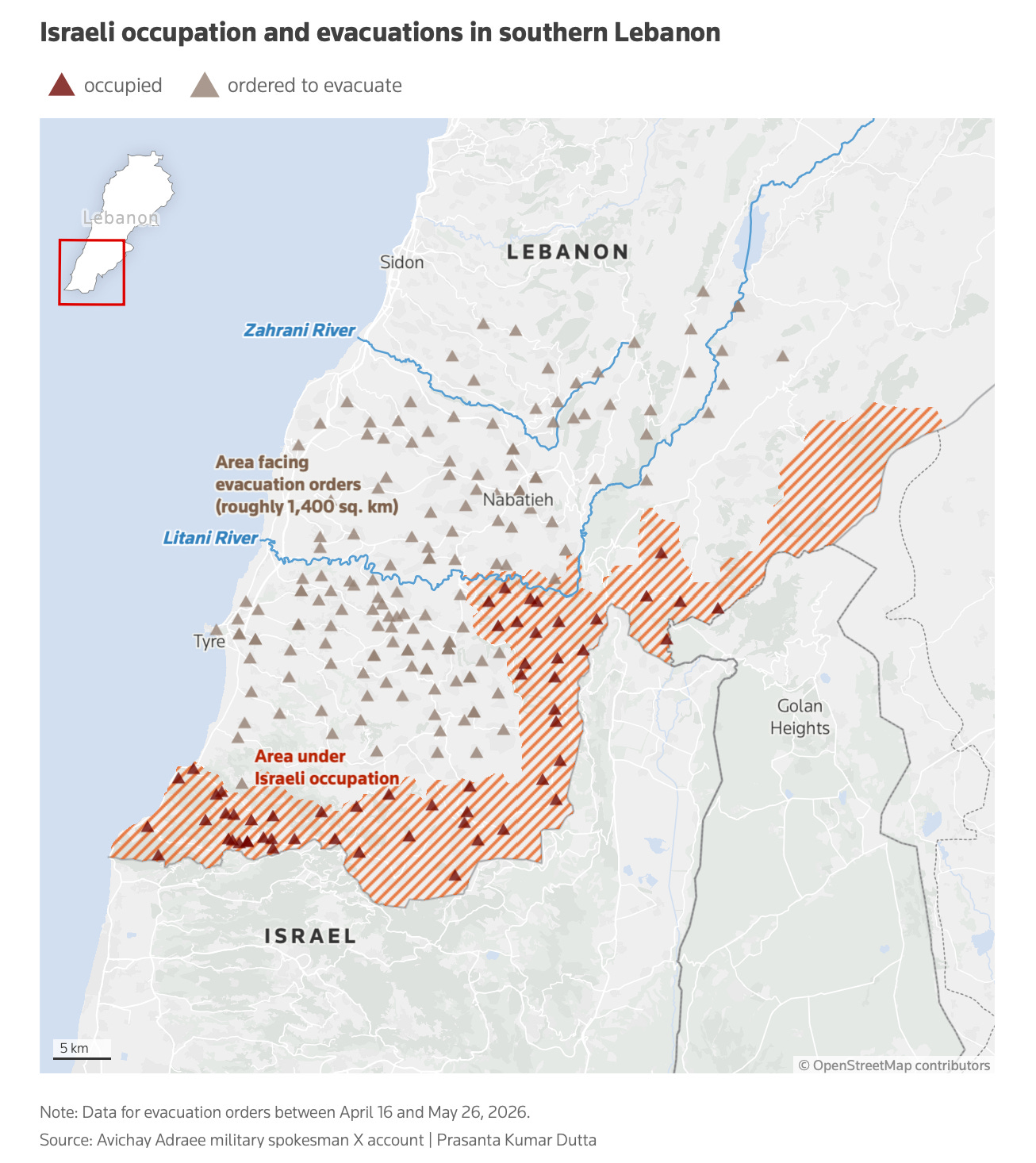
MAP - Reuters, 28 May 2026

CONSEQUENTIAL OBSERVATIONS —
Parliament Speaker Nabih Berri: ‘The Resistance will abide by Ceasefire as long as the Enemy comprehensibly adheres to it’ (Al-Akhbar, 19 June 2026):
Hezbollah stressed that the deadline for the enemy to fully withdraw from Lebanese territory does not exceed two months, during which it is expected to strictly adhere to the cessation of hostilities on land, at sea, and in the air, and to begin the withdrawal without the need for any direct negotiations. [Parliament Speaker] Nabih Berri confirmed — “To facilitate the success of the Iranian-American negotiations ... I reaffirm Lebanon’s position and Hezbollah’s commitment to the ceasefire, as long as Israel adheres to it fully and comprehensively” …
Head of the Loyalty to the Resistance [Parliamentary] Bloc, Mohammad Raad, called on the government “not to underestimate Iran’s ability to fulfill its commitment to deter the Zionist enemy should it persist in violating the provisions of the MoU that include Lebanon”. He affirmed that “the enemy has two months to withdraw completely from Lebanese territory, during which it must begin its withdrawal without the need for any direct negotiations”, adding, “After reaching a national understanding, the government can adopt a formula of indirect negotiations with the enemy to reactivate the Armistice Agreement in a manner that reflects the current reality, given the continued state of hostility, which is enshrined in the National Pact and the Constitution.” Raad emphasised “the enemy’s war to eliminate the Resistance in Lebanon has failed and will not achieve its objectives … [The Resistance] is ready for an internal national understanding that guarantees the security, stability, and national sovereignty of Lebanon”.
[Meanwhile, US-led] negotiations [between Lebanon and Israel continue] … During these meetings, key principles were emphasized, most notably a ceasefire, Israel’s withdrawal from Lebanese territory, the deployment of the [Lebanese] army to the international border, the return of prisoners, and the launch of the reconstruction process, according to Baabda sources. The Lebanese government appears determined to continue making concessions and insists on separating the direct negotiation track from the US-Iranian understanding, at a time when Arab and Western countries are pushing to build upon the Washington-Tehran understanding as a basis for any regional settlement.
For its part, Israel is treating the period of relative calm as an opportunity to reshape the reality on the ground by publishing a map of what it calls a “security zone” extending approximately ten kilometers into Lebanese territory. This includes reinforcing its positions north of the Litani River and establishing new military deployment lines, thus transforming territorial control into a bargaining chip for future negotiations. The Israeli strategy is based on combining tactical de-escalation with a hardening of political demands, particularly regarding Hezbollah’s weapons, linking any progress in negotiations to changes on the ground … Meanwhile, the US Treasury announced sanctions against Lebanese officials allied with Hezbollah, most notably [Maronite Christian] Marada Movement leader, Suleiman Frangieh … Franjieh asserted that the sanctions “will not affect our opinion but rather strengthen our conviction in it.”
The Ceasefire Deal: The price preventing Iran’s retaliation against Israel was a complete halt to Israeli attacks across ALL of south Lebanon (Ibrahim Al-Amine, Al-Akhbar, 15 June 2026):
Trump was negotiating with Iran over the price to be paid in exchange for preventing its retaliation against Israel. And that was when he heard the harshest statement of all – the one that required him to take the hardest course of action: Iran demanded a halt to the shelling of the entire south, not just Beirut’s suburbs! Trump was quick to respond in principle. He tweeted that he had asked Netanyahu to halt the shelling across the whole of Lebanon. He resumed contact with the mediators whilst awaiting Iran’s response. However, Iran stated that the only chance to salvage the situation was that, provided the agreement was finalised and the dispute over the signing date resolved, the most important thing now was to immediately begin implementing the ceasefire resolution – a step that concerned Lebanon exclusively. Trump had to communicate swiftly and intensively with Netanyahu … It does not appear that Israel is in a position to hold out for long, particularly when US national security is at stake … [Netanyahu] told Trump that he would comply with his request, but that he wanted to meet him quickly ... as matters needed to be discussed. But Trump was only interested in the first step: Go and tell your army to stop the war in Lebanon immediately… and all will be well!
IDF current “evacuation orders” amount to a total of 15% of Lebanon (Amnesty International):
Within the first 48 hours of the 2026 escalation, the Israeli military issued its largest mass “evacuation” order to date, covering all areas south of the Litani River – around 8.5% of Lebanon. A few days later, the Israeli military issued an even broader order, covering the area south of the Zahrani River, roughly 10% of Lebanon and home to some 800,000 people. The Israeli military republished the same order 13 times until 17 April 2026, when a ceasefire was declared. Hostilities continued, at a lower intensity at first, before escalating again. On 27 May 2026, the Israeli military issued the incredibly broad order again, instructing all residents of southern Lebanon to evacuate north of the Zahrani river, stating that the Israeli military considers “all the areas south of the river … combat zones”. New orders also included villages above the Zahrani river, amounting to 15% of the whole country.
On 20 April 2026, three days after the 17 April ceasefire was announced, the Israeli military published published a map designating a “Forward Defence” zone extending 8 to 12 km into Lebanese territory and covering about 600 km² of land and sea. The Israeli military listed 74 villages, barring residents from returning to 53 villages and from crossing south of 21. The Israeli military also prohibited approaching the Litani river and al-Salhani and al-Saluki valleys. The April 2026 map expanded the map of the no-return zone published by the Israeli military on 28 November 2024, the day after a previous ceasefire went into effect. The 2024 map covered roughly 480 km², or 4.6% of Lebanon and listed 68 villages, including 58 where residents were barred from returning and 10 where crossing south was prohibited.
IDF offensive NORTH of the Litani River — The Strategic Importance of the Ali al-Taher Heights Battle in south Lebanon (Zeinab Al-Saffar, Substack):
The Ali al-Taher Heights represents the dominant topographical nerve of southern Lebanon. [Israel’s] desperate push towards it doesn’t stop at merely seizing this “key to fire” overlooking Nabatieh and the Iqlim al-Tuffah region. Rather, it stems from intelligence concerns alleging the existence of a sophisticated [Hizbullah] missile infrastructure beneath these heights, which Israel seeks to dismantle before any potential withdrawal … [However] despite the seriousness of the violations, shelling, and intense airstrikes, it is unlikely to completely derail the Agreement, as the understanding was formulated under major international auspices that transcend the specifics of the situation in southern Lebanon. However, it places the Agreement in “intensive care” and establishes a critical phase of eroding red lines before the final establishment of the truce. This is especially true considering the Israeli army’s failure to capture the heights thus far, despite confirmed casualties among its ranks … described as the fiercest [battles] since the start of the war ...
Failure to secure the Kfartebnit-Ali al-Taher axis would effectively render all Israeli positions north of the river militarily untenable … Should the Resistance succeed in [repelling the IDF’s offensive], every Israeli soldier north of the [Litani] river effectively becomes a vulnerable military target … [This] would lay the groundwork for an eventual Israeli retreat south of the river … Hezbollah understands the enemy’s strategic predicament: It believes Israel now considers success at Kfartebnit essential to sustaining its broader position … The substantial [IDF] losses incurred there are portrayed as a reflection of strategic desperation, with offensive operations increasingly resembling a gamble in blood after the exhaustion of more viable military options.
Saudi-led Regional Coalition addresses “’organised gradual transition’ rather than forced disarmament [of Hizbullah]” (Michael Young, The National):
In recent months, the Saudis have been working with Turkey, Egypt, Qatar and Pakistan to contain Israeli power in the region while also striving to reduce tensions inside Lebanon and avoid any kind of domestic conflict. In trying to contain Israel, the five countries are not acting out of any ideological rationale. … [They] are just as keen to prevent Iranian hegemony as they are Israeli … [They informed] a major interlocutor with Hezbollah ... that they did not want sectarian violence in the country. In line with this aim, the Egyptians last year formulated a plan for the “containment” of Hezbollah’s weapons – as opposed to its forcible disarmament ... A document outlining this plan is currently circulating and, according to those familiar with it, had Saudi input … The inclusion of Taif in the effort suggests that the Saudis view Hezbollah’s surrendering of its weapons – in a process described in the document as an “’organised gradual transition’ rather than forced disarmament” – to be part of a broader effort to give the Shiite community a greater role in the state in exchange for the group’s weapons. Hezbollah presented its observations on the document, but these indicate that more negotiations are needed ... It is conceivable that the Pakistanis are [currently] helping to define a role for the [Lebanese] army in the south that would avoid a clash with Hezbollah, one that could obtain Iranian endorsement …
The key takeaway from the initiative ... is that Lebanon is better off relying on a regional approach to the Hezbollah problem than on a scheme designed to precipitate [Lebanon’s] armed forces into a devastating confrontation with the group … Hezbollah and its arms represent much more than a local issue for Lebanon. They feed into regional rivalries, which suggests strongly that only a regional solution – one involving members of the coalition of five states, along with the US, and, most importantly, Iran – can secure an acceptable outcome.
Enemies of the Resistance Paving the Way for ‘Internal Chaos’ (Ibrahim Al-Amine, Al-Akhbar, 19 June 2026):
This is how the scene was hastily arranged a few days ago, after Washington was informed that Tehran did not wish to sign the agreement in person, nor did it want any handshakes or hugs. At Versailles, the US President was attending a dinner held in his honour … Suddenly, US Secretary of State Rubio approached Trump carrying some papers ... At that point, Trump addressed those present, saying: ‘I am now signing the MoU with Iran, and on the other side of the room sits the Iranian President, Pezshikian, to do the same’ ... The dinner ended ... marking the start of a new phase of tough negotiations between Iran and the US …
Paris, which still believes it is entitled to play a central role in Lebanon and Syria ... It continues to try to appease Tel Aviv … [Macron] attempted to exploit the killing of two [French UNIFIL] soldiers on 18 April, despite knowing that the French force was providing field support to the occupying forces by entering areas linked to the resistance’s operations … The French continue to commit transgressions, the latest of which was the launch of reconnaissance drones over Lebanese territory during the clashes, thereby providing the enemy with information that helped it target the resistance and its support base. The irony is that France is behaving as if others are unaware of what is happening or lack information about its actions.
However, the French stance is not the only thing marring the supposed calm ... Indeed, one can now speak of the depth of hatred that dwells in the hearts of senior [Lebanese] state officials and politicians, who do not oppose the continued presence of occupation forces in the south ... More dangerously still, those who assume ... that a ceasefire in Lebanon will not come about through the resistance and Iran, are showing a willingness to make concessions that go far beyond what the Lebanese people believe, and are prepared to go to great lengths to appease Israel, even if the price is exposing the country to the risk of civil war … President Aoun and PM Salam ... agreed that current developments were not in their interests, and that they must do whatever is necessary to thwart them ... Instead of capitalising on the changes that have taken place and engaging with the US to explore a mechanism leading to a phased withdrawal of the occupying forces in exchange for the deployment of the Lebanese Army south of the Litani River, they are moving towards signing a security agreement with Israel, the aim of which is the very same as that sought by Israel: the disarmament of the resistance across the whole of Lebanese territory.
[Nevertheless, Trump] appears eager to consolidate the agreement with Iran. For the first time, those around him have succeeded in convincing him that the Lebanese issue cannot be separated from the Iranian one. According to a US source, Trump has, for the first time, realised the nature of the relationship between Iran and Hezbollah; consequently, he now favours direct communication and has no objection to his representatives holding direct meetings with the party, provided the latter agrees. What matters to Trump today is finalising the arrangements to end the war in Lebanon, the main aim of which is to secure a complete Israeli withdrawal … The Americans discussed with Israel the need to agree on a security plan for its withdrawal from Lebanon in exchange for security arrangements to be implemented by the Lebanese state under US supervision, with the aim of ensuring that Hezbollah is kept away from the border and securing a pledge from the party not to carry out any military operations against the enemy entity.
Whilst the Americans, along with Israel, are seeking to achieve this objective … Aoun and Salam, along with other Lebanese forces, do not want matters to proceed in this manner; rather, they are pushing for an agreement that imposes the comprehensive disarmament of the party and allows for steps to be taken to dismantle its political, organisational and social structure, whilst simultaneously striking at its institutions and instruments operating in the social and economic spheres … Aoun and Salam, with clear Saudi backing, wish to link Lebanon’s reconstruction to the issue of disarmament. For this reason, they are now rushing to launch a series of measures aimed at stepping up security surveillance of resistance elements in Lebanon ... in addition to a ‘mad scheme’ being pursued by the [Governor of] Banque du Liban … [aimed at] dismantling the ‘Al-Qard Al-Hasan’ institution and tightening financial restrictions ... Although Hezbollah has been officially informed by the Minister of the Interior and the Minister of Finance that they will not proceed with this project, matters may take a different turn …
In short, Aoun and Salam, along with the faction opposed to the Resistance, are preparing to commit the gravest of crimes by entering into a security agreement with Israel, which is due to be finalised within a week or by the end of this month, followed by the setting of a date for Aoun’s visit to the White House, where the agreement is expected to be signed … Trump wants to give Netanyahu a card to play in Tel Aviv to justify any potential withdrawal from Lebanon, but something could happen to derail this entire plan. This is not only a matter of self-deterrence, but also of the possibility that the process could be derailed by other factors concerning the US and Israel, as well as the countries in the region, which have entered a phase of comprehensive reassessment of their strategies in light of the outcome of the MooU between Washington and Tehran.

THANK YOU to all our readers and subscribers, especially our paid subscribers. This site is fully reader-supported and reader-funded, and we are very grateful for readers’ support.
Hizbullah suffers as a non-state actor. Without a sufficient industrial base, Hizbullah cannot continue the resistance for the longer term. If Iran cannot do enough for Gaza (too far) and Egypt is not willing (bought off by the US), then Gaza is a goner, and Iran has to protect Hizbullah one way or another.
However, as an outsider without any experience in the region. I see that Hizbullah CAN be severely strangled in a way similar to strangling Gaza: (1) Seal off the eastern boundaries of Lebanon facing Syria. (2) Seal off the north side of Hizbullah by boosting the Lebanese government to maintain transport barriers from Turkey, Syria, and between Lebanon and Hizbullah-controlled zones. The Lebanese army does not need to move south, only to stop the blood flow to the south. (3) Israel's naval forces will seal off the Mediterranean side. As a result, Israel will claim all natural resource rights under the sea and strangle Hizbullah's economic relationship with other zones.